FindU
Find Your FitFor CollegesAboutBlog
Sign inGet Started
Home/Blog/No idea what to major in? Good. Here's what to do instead of panicking
Planning

No idea what to major in? Good. Here's what to do instead of panicking

Kenny Morales·March 15, 2026·6 min read
No idea what to major in? Good. Here's what to do instead of panicking

Every college application asks the same question: "Intended major." And you're sitting there like... I don't know. Business? Is that a thing people just pick? Should I say engineering because it sounds smart?

Deep breath. You're not behind.

Somewhere between 20% and 50% of students enter college without a declared major. And of the ones who DO declare one, 75% change it at least once. That means almost nobody actually knows what they want to study at 17. The people who seem sure? Half of them will switch to something completely different by sophomore year.

So if you don't know, you're not broken. You're normal. The real question is: how do you figure it out without spiraling?

Why the quiz approach doesn't work

You've taken the quizzes. "Answer 20 questions and we'll tell you your perfect major!" You clicked through, got "Communications" or "Business Administration," and thought... okay? That doesn't help.

Those quizzes are fun but they're basically horoscopes with a .edu domain. They can't account for what your life actually looks like. Your financial situation, where you want to live, whether you'd rather work with people or alone, whether you need a 9-5 or would lose your mind in one.

A major isn't just what you study. It's the first filter for what your life looks like after graduation. And a 2-minute quiz can't capture that.

Try the backwards method

Instead of asking "What do I want to study?" ask "What kind of life do I want?"

Start here:

  • What does your ideal Tuesday look like? Not Saturday. Tuesday. That's the real test. Are you in an office? A hospital? A studio? Outside? Working alone at a computer or in a room full of people?
  • How much money do you need to be comfortable? Not rich. Comfortable. What does that number look like? Be honest. If you need $80k to feel stable and the career you're eyeing tops out at $40k, that's worth knowing now.
  • Where do you want to be? Big city? Small town? Does it matter? Some careers only really exist in certain places. Film in LA. Finance in New York. Agriculture in the Midwest. Your major and your location are more connected than you think.
  • Do you want structure or flexibility? Some people need a clear path. Engineering, nursing, accounting. You know exactly what you're doing every semester. Others want to explore. That's fine too. But the path you pick affects your college experience starting day one.
  • Once you can picture the life, work backward to the careers that match. Then work backward to the majors that lead to those careers.

    Student watching career day-in-the-life videos on a laptop

    Try it before you buy it

    You wouldn't commit to a relationship after reading someone's bio. Don't commit to a major after reading a course catalog.

    Here's how to actually test-drive it:

  • Shadow someone for a day. Find a person who does what you think you want to do. Ask if you can follow them around for a day. Most people will say yes. You'll learn more in 8 hours than in 8 months of wondering.
  • Take a community college class. Over the summer, take an intro course in something you're curious about. It costs almost nothing and you'll know fast whether it's your thing.
  • Watch day-in-the-life content. YouTube and TikTok are full of people filming their actual workdays. Search "[career] day in the life" and watch 5 of them. You'll feel either excited or bored within minutes. Trust that gut reaction.
  • Talk to 3 people. Find 3 people who have the job you're curious about. Ask them: What do you actually do every day? What do you wish someone had told you before you started? Would you pick this path again?
  • Student in a library looking up thoughtfully, imagining future career paths

    Undeclared isn't a death sentence (but know the tradeoffs)

    Most schools let you explore for 1-2 years before you have to declare. That's a real option and there's no shame in it. You'll take gen eds, try different classes, and figure it out as you go.

    But here's what you need to know:

  • Some majors have early prerequisites. Engineering, nursing, pre-med, architecture, and some STEM fields have sequenced course requirements that start freshman year. If you wait until sophomore year to decide on engineering, you might be a year behind.
  • That's okay. It just means an extra semester sometimes. Not ideal but not the end of the world.
  • Undeclared doesn't mean unfocused. Use your first year intentionally. Take intro courses in 3-4 different areas. Keep a running list of what you liked and what you didn't. That's not indecisive. That's smart.
  • Your major affects your college list

    This is the part people miss. Your major and your school choice are the same decision.

    If you're leaning pre-med, you want a school with strong sciences AND a good med school acceptance rate. If you want to study film, a school in LA or New York gives you access to an industry that doesn't exist in most other places. If you want engineering, some schools are known for it and others just offer it as an afterthought.

    And if you're undeclared, you want a school with a strong advising program for exploratory students and a wide range of departments to choose from. A small liberal arts college might be great for this. A huge university with 200 majors might also be great. It depends on how you learn best.

    The point is: even if you don't know your major, thinking about what you might want to explore helps you pick a better school.

    Two students walking confidently down a campus path together

    You don't have to know. You just have to start.

    The pressure to "know what you want to be" at 17 is insane. Most adults in their 30s are still figuring it out. You don't need a life plan. You need a direction. And directions can change.

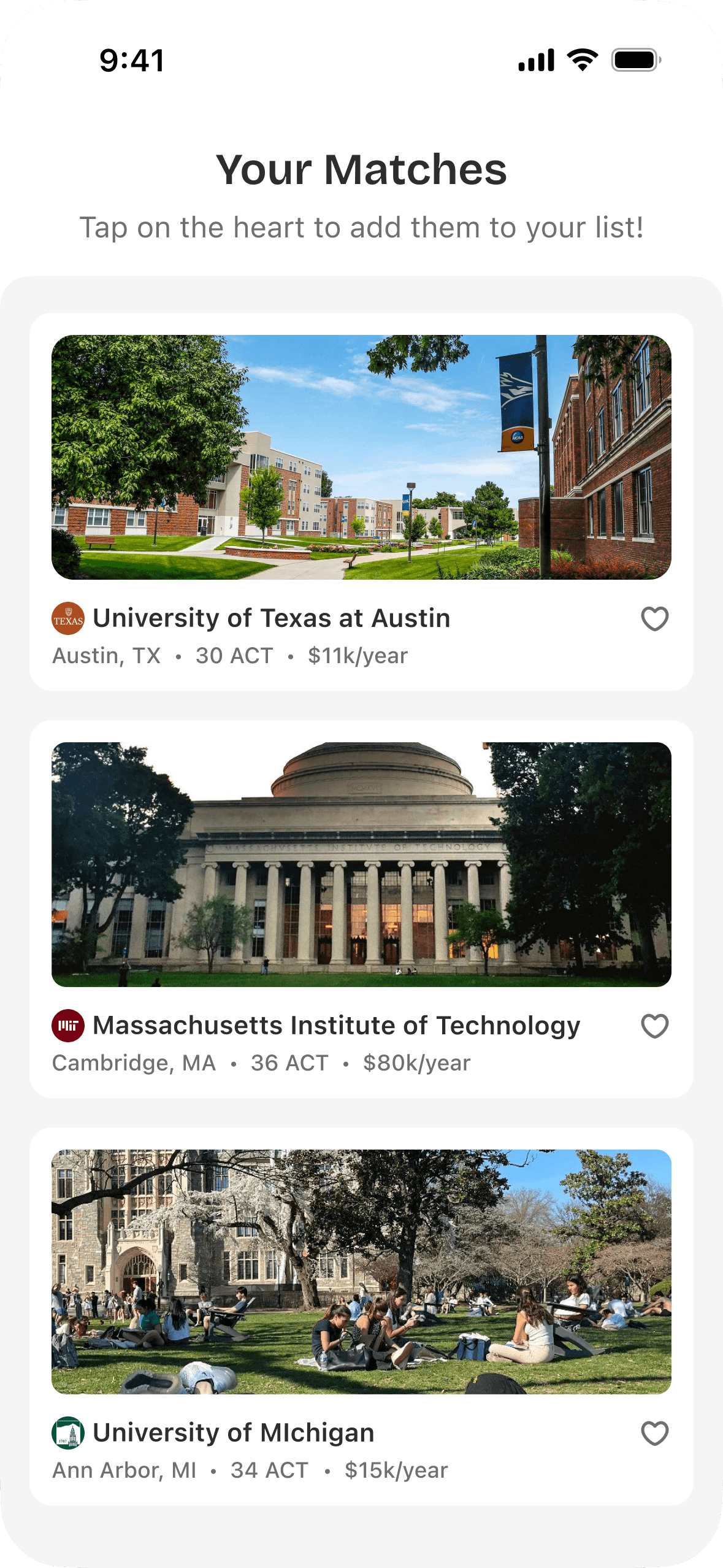
    Tell FindU what you're interested in. Even if it's vague. Even if it's 3 completely different things. We'll show you schools that match, so you can explore without limits.

    The only wrong move is not moving at all.

    Keep reading

    You got into multiple colleges. Now how do you actually pick one?

    March 15, 2026·6 min read

    Your financial aid offer is trash? Here's how to get a better one

    March 15, 2026·7 min read

    SAT vs ACT: which one should you actually take?

    March 15, 2026·6 min read

    Your college isn't going to find itself.

    Download App
    FindU Your Matches screen
    FindU

    Find Your Fit

    • Take college quiz
    • Chance Me calculator
    • Scholarship search
    • College Search
    • Browse all tools

    Company

    • About
    • Blog
    • Careers

    For Partners

    • For Colleges
    • For Counselors
    • Contact Us

    Legal

    • Privacy
    • Terms

    Join our newsletter